I know this is a phrase we hear over and over again, but after I was introduced to TRE I didn’t understand why I hadn’t heard about it before. This is a powerful technique that could benefit many people.
TRE stands for Trauma and Tension Release Exercises and it a natural way for the Nervous System to release stress and return to a ‘rest and digest’ state.
There are essentially three states of your nervous system: the ventral vagal, which is rest and digest; the sympathetic, which is fight or flight; and the dorsal vagal, which is shut down. Most people are not educated to the different nervous states and thus are unable to identify which state they are living in or are able of changing state.
Because of this many people live in a fixed state of flight or fight or immobilisation (shut down.) Living in this state for prolonged periods can affect your physical health, leading to issues such as muscle tension and pain, heart disease, heart attack, high blood pressure, stroke, sleep problems and weight gain.
Ventral Vagal allows for social engagement. It is a state in which we feel grounded and connected, naturally open and curious and able to connect with the things and people around us on a deeper level. This is a state that feels good — where true mindfulness is available.
So how do we get there?
This is where TRE comes in. By using a series of exercises to fatigue major muscle groups one can access their natural, instinctual tremor. Whilst the tremor itself is involuntary, one can come in and out of the tremor voluntarily. The tremor is thought to ‘reset’ the central nervous system as well as release trauma caused bodily tensions by vibrating through the tensed muscle memory.
The exercise consists of 6 standing and one lying down exercise with the latter inducing the tremor, all of which takes 20 minutes to complete. With practice one is able to induce a tremor without the exercises and release pent up stresses anytime there is a spare 5 minutes. Life changing stuff.
Exercise 1: Stretching the ankles
1. Spread your legs shoulder width apart.
2. Sway to one side by rolling onto the sides of your feeling. You should be standing on the outside of one foot and on the inside of the other foot. Hold this position for a few seconds and then sway to the other side.
3. Continue slowly swaying back and forth for about 5 to 8 times in each direction.
4. Once done, shake out your feet.
Exercise 2: Stretching the calf muscle
1. Place one foot in front of you and put all your weight onto that foot. Keep the back leg on the floor just for balance.
2. Lift the front heel off the ground as high as you feel is comfortable and go up and down on your toes. Repeat for about 5 to 8 times.
3. Once finished, shake the leg you just exercised.
4. Repeat the same with the other foot.
Exercise 3: Stretching the upper legs
1. Place one leg in front of the other.
2. Lower your hips slightly as if you are about to sit on a chair. This will cause the knee of your front leg to bend. Do not let it bend beyond the length of the foot. Keep bending and straightening your standing knee for about 5 to 10 times.
3. Once finished, shake the exercised leg.
4. Switch to the other leg and repeat the same.
Exercise 4: Stretching your inner legs, hips, and back
1. Stand with your legs spread a comfortable width apart.
2. Fold forward, bending the knees. You may not put your hands on the ground if that is too difficult.
3. With your hands in the center, take 3 deep breaths and relax by allowing gravity to naturally stretch your body.
4. Then slowly walk your hands to one foot. Hang onto the leg or the floor and hold this position for three slow, deep breaths.
5. Go over to the other foot. Hold this position for three deep breaths.
6. Move your hands back to the center and reach between your legs behind you. Hold this position for three deep breaths.
7. Once finished, go back to standing position and place your hands for support as you stand.
Exercise 5: Stretching the front of the body
1. Place your feet beyond hip-width apart.
2. Place your hands partly on the lower back. You can look down or up.
3. Bend your knees slightly and bow your back slightly as you move your hips forward.
4. Gently rotate to one side, looking behind and keeping the bowed position. Take three deep breaths.
5. Come center and rotate in the opposite direction. Take three deep breaths.
6. Return to the center position. Take three deep breaths and come standing in a normal position.
Exercise 6: Wall sit exercise/stretching upper leg muscles
1. Sit with your back against the wall as though you were sitting on a chair, feet a comfortable distance apart.
2. Once it becomes slightly uncomfortable, move up the wall about an inch or two.
3. Again if this becomes too uncomfortable, move up the wall about an inch or two. The goal is to allow your legs to tremor/shake without pain.
4. After about 3 to 5 minutes, push off the wall to a standing position.
5. Bend your knees slightly and allow yourself to hang forward. It is normal for the body to start shaking in this position. Touch the ground with your hands and stay there for a minute if possible.
Exercise 7: Floor sequence
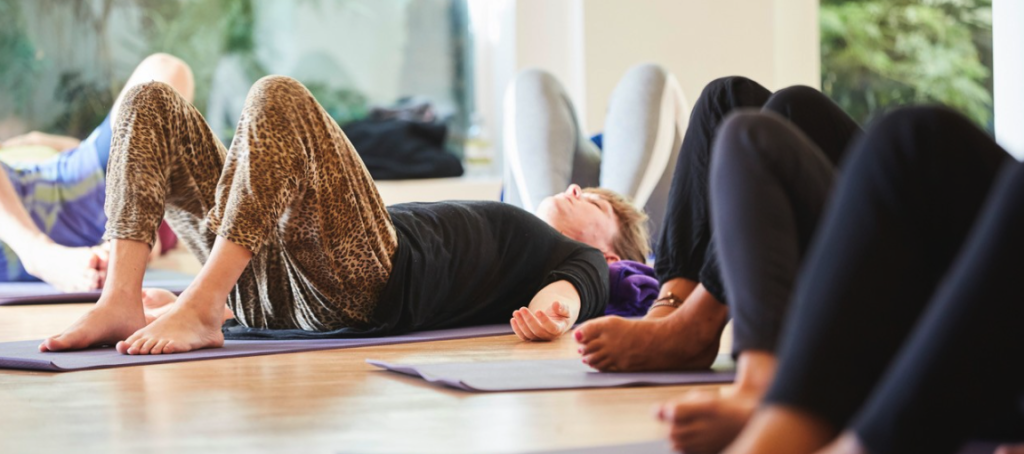
1. Lay on the floor and bend your knees.
2. Open the knees wide in a rest position with your foot soles touching and the heels close to your body.
3. From that position, lift your hips off the ground for 30 seconds to one minute.
4. Gently set your hips down on the ground and let your knees relax for a minute.
5. Slightly close your knees about an inch or two and hold this position for two minutes. It is normal for you to experience tremoring/shaking in this position. If it gets uncomfortable stop by stretching the legs out and pulling the toes back.
Practice allowing your body to tremor without your mind interfering for around 5 minutes. Take a break by laying the legs flat and breathing deeply and smoothly into your belly. Do this for another two rounds of 5 minutes. Once complete, allow yourself to relax into your body, laying in anyway that feels right, perhaps with a blanket for comfort, continue to breathe deeply as you allow yourself time to integrate the change has occurred.
It is often recommended to do your first session with a certified TRE practitioner so they can help you through the first session since it is possible for memories to surface whilst tremoring. This is particularly important for people with PTSD and CPTSD.
With a large release it is likely you will feel lighter, smoother and more present.
After many releases, the body can hint when it needs a release. This may come in the form of a slight shake or twitch in body parts. For some that can be a gentle shake in the fingertips, or an eyelid flutter.
This technique is incredibly useful in releasing the stresses and strains we pick up through the day, following the fast pace that modern society sets. By using this technique we are ensuring health and longevity in our mind and body.